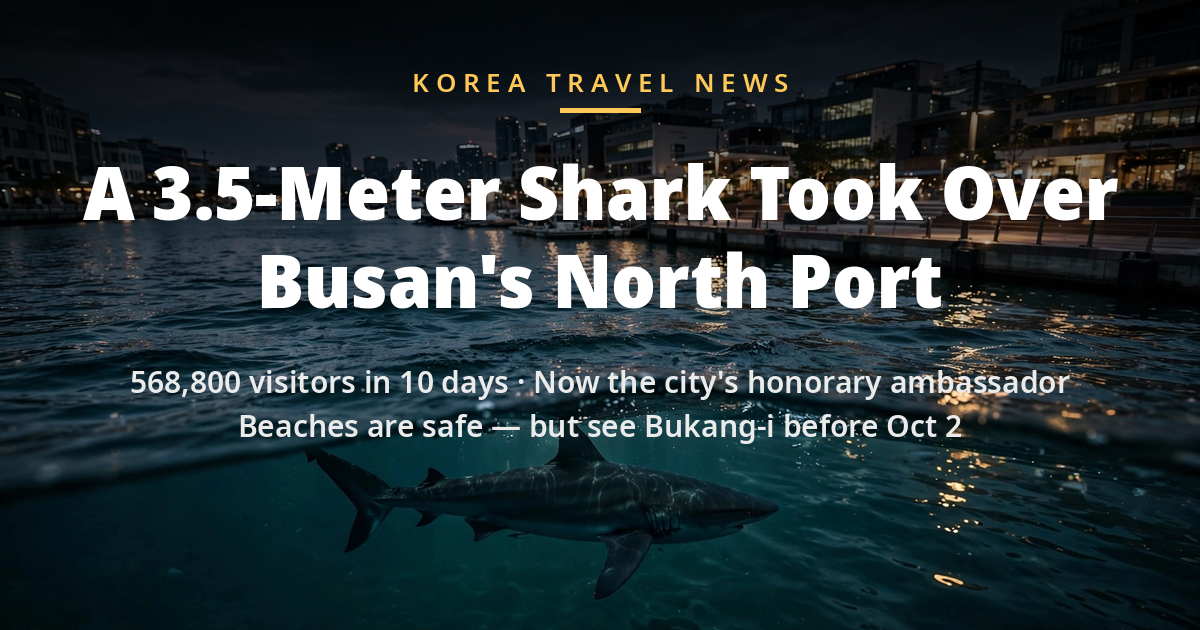
TL;DR: On September 18, 2026, a 3.5-meter shark — believed to be a copper shark — swam into an artificial canal at Busan’s North Port Waterfront Park and stayed. Nicknamed “Bukang-i,” it drew 568,800 visitors in ten days, was named Busan’s honorary ambassador, and survived a failed rescue attempt on September 29. Busan’s beaches are unaffected: the shark is in a man-made waterway, not the open sea. Last updated September 30, 2026 — the next rescue attempt is scheduled for October 2.
What happened
On the morning of September 18, 2026, visitors at the North Port Waterfront Park (북항친수공원) in Dong-gu, Busan, spotted something unexpected gliding through the park’s artificial canal: a shark measuring an estimated 3 to 4 meters long, identified by Korea’s National Institute of Fisheries Science as a copper shark (무태상어, Carcharhinus brachyurus), also called the bronze whaler.
The Busan Coast Guard initially tried to drive it out to sea. The shark refused to leave. Rather than risk stressing or injuring the animal — or provoking aggression — officials decided to monitor it and wait for it to leave on its own.
It didn’t. Koreans, meanwhile, fell in love with it. Social media dubbed it “Bukang-i” (부캉이) — a combination of Bukhang (the Korean name for North Port) and the affectionate suffix -i. Between September 19 and 28, an estimated 568,800 people visited the park to see it, including 483,000 over the four-day Chuseok holiday alone. On the peak day, September 26, 140,000 people showed up — roughly 70 times the park’s normal holiday traffic of about 2,000 a day.
Is it safe to swim in Busan?
This is the question travelers are actually asking, so here’s the direct answer: nothing about Bukang-i affects Busan’s swimming beaches.
Bukang-i is confined to an artificial canal inside a waterfront park — not the open sea, and not anywhere near a swimming beach. Authorities have announced no beach closures related to the shark. It has shown no aggressive behavior; in fact, officials deliberately avoided provoking it during the entire 12-day stay.
One detail worth knowing: officials observed no feeding activity since the shark arrived, which is part of why they decided it couldn’t stay in the canal indefinitely.
Can you still see Bukang-i?
Possibly — but the window may be closing. Here’s the status as of September 30:
- September 29: Five vessels (including Coast Guard patrol and rescue boats) spent over five hours trying to herd Bukang-i toward the open sea using water pumps — spraying water behind the shark to create foam and noise that would nudge it toward the canal exit. The shark repeatedly swam back past the boats. The operation was called off around 3:20 p.m.
- October 2 (planned): Authorities will try again with a net custom-made to fit the canal’s width and depth.
The water-pump technique was modeled on a 2004 case in Massachusetts, where a great white shark trapped in a salt marsh was guided back to sea without being touched. If the October 2 attempt succeeds, Bukang-i will be gone — so if you want to see it, sooner is better than later.
Getting there: The North Port Waterfront Park is in Dong-gu, at Busan’s North Port redevelopment waterfront. Search “북항친수공원” in Naver Map. Expect crowds on weekends — visit on a weekday morning for the thinnest crowds.
Why all of Korea is obsessed
Bukang-i became a genuine cultural phenomenon in under two weeks:
- Honorary ambassador: Busan ran an Instagram poll — 91% of 8,200 respondents voted yes — and officially appointed the shark as the city’s honorary promotional ambassador on September 29.
- Economic ripple: CU convenience stores near the park saw sales jump 76.7% in the week after the sighting. Shark-adjacent snacks surged too — Jaws ice cream bars up 54.7%, Goraebab (whale-shaped crackers, which contain a shark character) up 29%.
- Trademark drama: On September 25, just a week after the sighting, an individual filed a trademark application for “BUKANGI 부캉이” covering 40 product categories — keychains, apparel, plush toys — before the city or any public agency had secured the name.
- The bigger picture: Marine biologists note the appearance may be linked to warming seas. As ocean temperatures rise, the fish sharks prey on move northward — and sharks follow their food. (Choi Youn, marine biology professor at Kunsan National University.)
FAQ
What kind of shark is Bukang-i?
Identified by Korean authorities as a copper shark (무태상어, Carcharhinus brachyurus — also called bronze whaler), estimated at 3 to 4 meters long.
Is it dangerous?
It has shown no aggressive behavior in 12 days, and experts deliberately avoided stressing it. Still — it’s a wild 3.5-meter shark. Watch from the waterfront promenade, not the water.
Are Busan’s beaches closed?
No. The shark is confined to an enclosed artificial canal, far from swimming beaches, and no closures related to it have been announced.
Will it still be there when I visit?
Uncertain. The next rescue attempt is scheduled for October 2, 2026. If it succeeds, the canal will be empty. Check Korean news before making a special trip.
Why “Bukang-i”?
Bukhang (북항) is the Korean name for North Port; -i (이) is an affectionate suffix Koreans attach to names. Roughly: “little North Port one.”