
Busan · Seafood markets
Busan has three seafood markets worth your time, and all three work the same way: buy downstairs, eat upstairs.
- Jagalchi
- Iconic, touristy
- Minlak (Gwangan)
- Locals’ pick, friendlier
- Gijang
- Crab specialist
- How it works
- Pick fish at a stall, eat on the restaurant floor, pay a table-setting fee
- In season (Oct–Nov)
- Wild shrimp and bangeo (yellowtail)Skip jeoneo (gizzard shad): overpriced this year
- Budget
- ₩30,000–50,000 (~$22–36) per person for hoeCrab is a separate budget
- Solo
- Solo diners welcome
Last updated 2026-10-13. Prices verified October 2026 — seafood prices move with the season, so treat these as anchors, not guarantees.
The 3 markets, compared
| Jagalchi | Minlak | Gijang | |
|---|---|---|---|
| Korean name | 자갈치시장 | 민락어민활어직판장 | 기장시장 (기장대게시장) |
| Vibe | Korea’s most famous — big, loud, touristy | Where Busan locals go instead | Crab country |
| Best for | First visit, the spectacle | Eating well without the tourist markup | Crab + king crab feasts |
| Price level | $$ | $–$$ | $$–$$$ (crab) |
| Getting there | Line 1, Jagalchi Stn, 2–5 min walk | Gwangan Beach area (Suyeong-gu) | Donghae Line, Gijang Stn, 6 min walk |
1. Jagalchi Market — the icon
Jagalchi is Korea’s largest seafood market and the one in every guidebook. The modern building: 1st floor is the live-fish market (tanks everywhere, ajummas calling out), 2nd floor is the hoe center where you eat. There’s a rooftop observatory and, yes, a noraebang on the 3rd floor.
- Address: 52, Jagalchihaean-ro, Jung-gu (Naver Map)
- Hours: 05:00–22:00 (stalls vary); closed 1st/3rd/5th Tuesdays, plus Seollal/Chuseok
- Entry: free. Upstairs, you pay a per-person table-setting fee (상차림비) — confirm the amount before ordering, as it varies by restaurant.
- Subway: Line 1, Jagalchi Station, 2–5 min walk. Info: 051-245-2594.
Good to know: it’s genuinely fun even if you don’t eat — the 1st-floor tanks are a spectacle. But it’s the most tourist-priced of the three, and touts can be pushy. Our tourist scams guide covers the market-specific tricks.
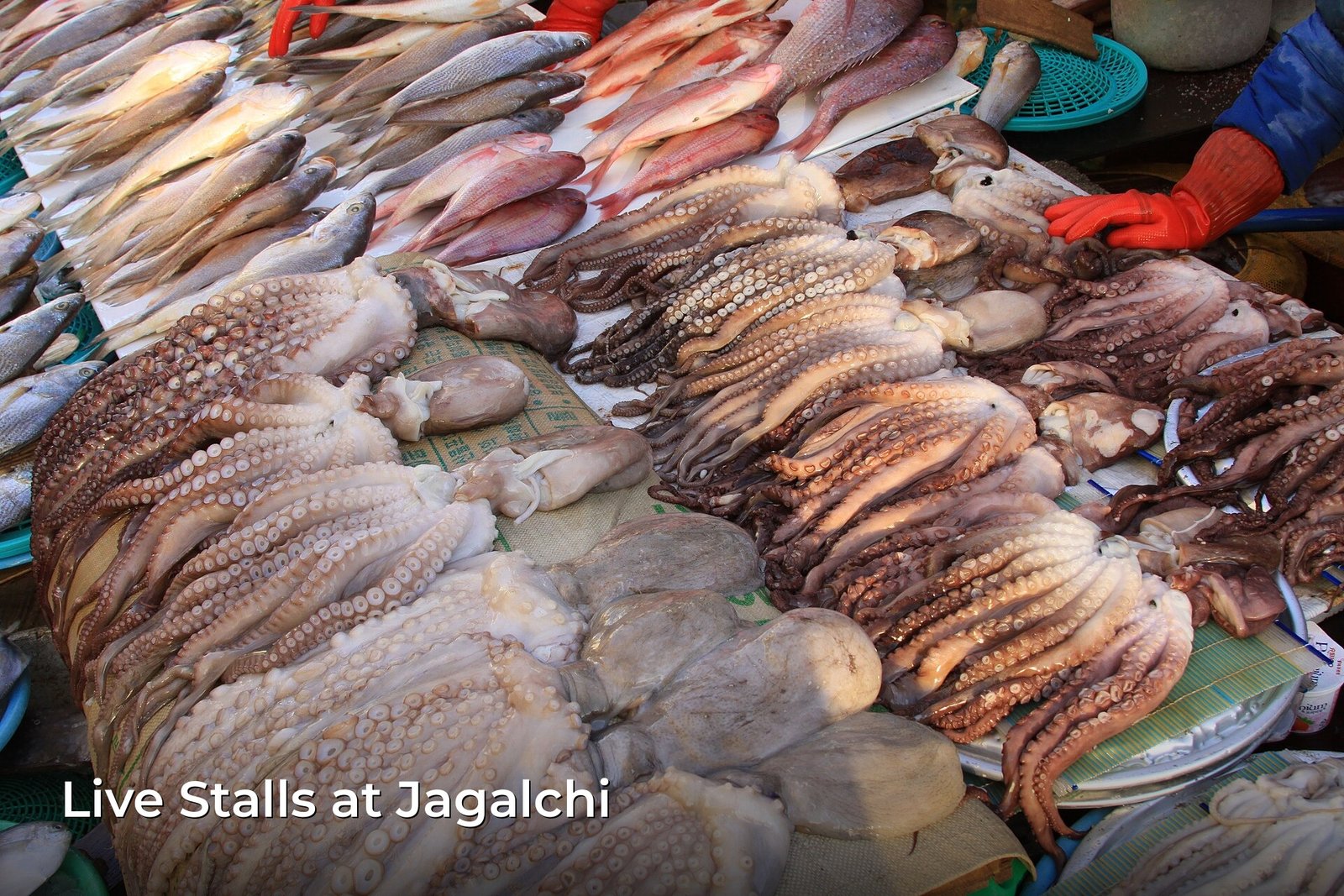
Live stalls inside Jagalchi Market. Photo: Czolya / Wikimedia Commons (CC BY 3.0).
Affiliate link: if you book, Korea Navigate may earn a small commission at no extra cost to you. Prices and availability are set by the booking site.
2. Minlak Fishermen’s Market — the locals’ pick
민락어민활어직판장 (Minlak Fishermen Live Fish Direct Sales Market), between Gwangan Beach and Minlak Waterside Park. The common description from Busan locals: “where we go instead of Jagalchi.” Less English spoken, friendlier to outsiders and solo diners, and prices run lower than Jagalchi for the same fish. Don’t confuse it with 민락회타운 next door — that’s a restaurant building, not the market.
- Address: 60, Gwanganhaebyeon-ro 312beon-gil, Suyeong-gu (Naver Map)
- Hours: 9:00–22:40 (per Busan Navi; hours can change, so check before you go), closed the 2nd and 4th Tuesday of each month
- Same system: buy on the 1st floor, eat at a 2nd-floor chojangjip. Some stalls will also deliver your purchase to a nearby restaurant.
- Price anchors: solo flounder (도다리) 2 fish ₩30,000 (~$22); 3-kind assorted hoe ₩100,000 (~$72).
- Look for the “Korea Seafood Festival” (대한민국 수산대전) sticker — 20% off at participating stalls.
3. Gijang Market — crab country
Gijang (aka Gijang Crab Market) is where Busan goes for crab. Snow crab (대게) and king crab (킹크랩), plus top-grade domestic hagfish (꼼장어). Same buy-downstairs, eat-upstairs system: 1st-floor live fish center, 2nd-floor chojangjip.
- Address: 16, Eumnae-ro 104beon-gil, Gijang-eup, Gijang-gun (Naver Map)
- Hours: market 06:00–21:00; crab restaurants 09:00–21:00, year-round
- Prices: snow crab ~₩60,000–70,000/kg (~$43–50); king crab ~₩90,000/kg (~$65, haggle + cash discount); upstairs table-setting fee ₩7,000 (~$5) per person
- Subway: Donghae Line, Gijang Station, Exit 1 → 6 min walk
- Pairs with: Haedong Yonggungsa Temple morning + Gijang crab lunch — that’s Day 3 of our Busan 2–3 day itinerary
Crab-season note: peak season is winter (December onward). In October, crab is available but not at its best or cheapest — check what’s in season before committing to the big-ticket crab.
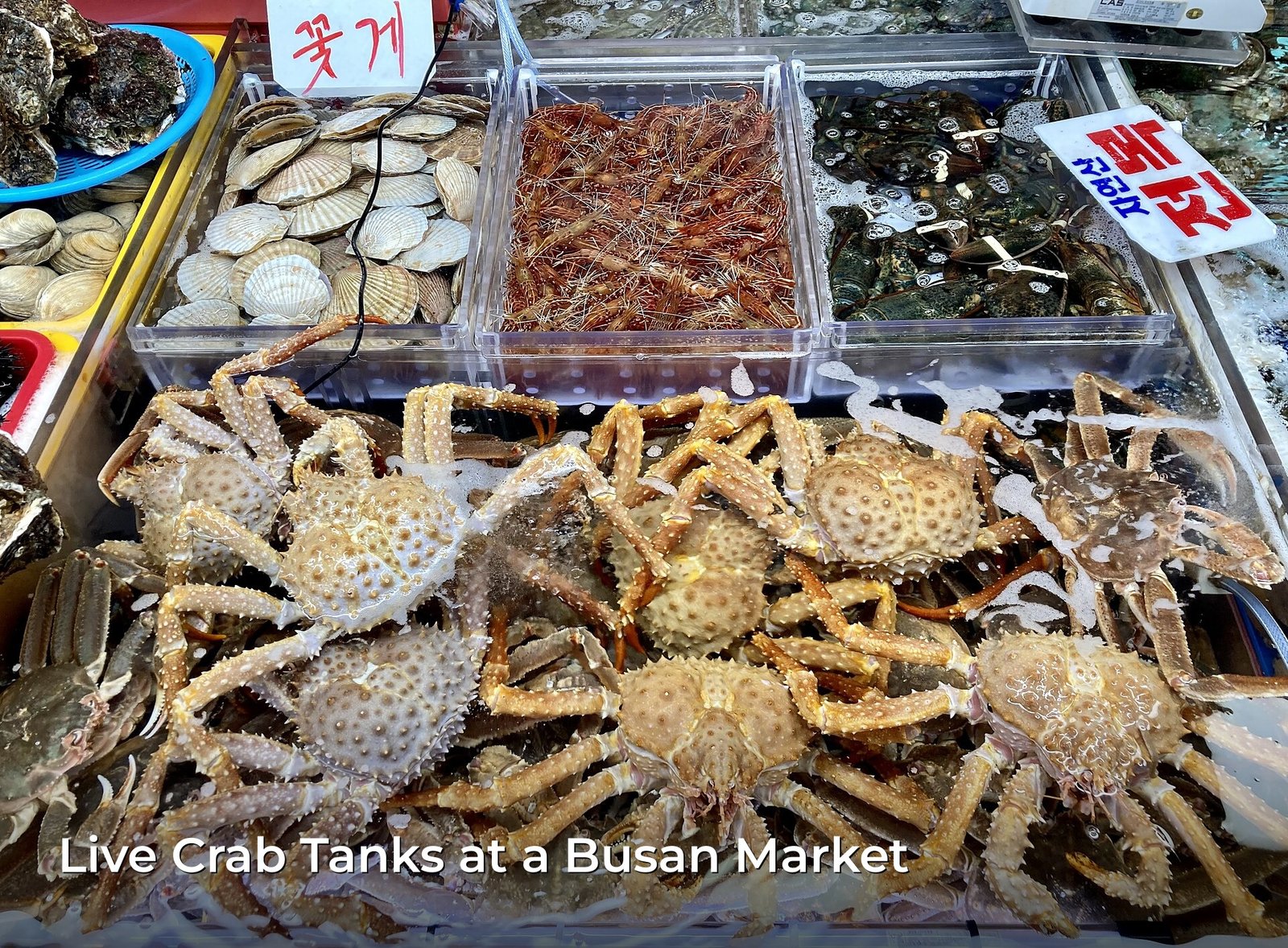
Live crab tanks at a Busan seafood market — Gijang is the crab capital. Photo: Dudva / Wikimedia Commons (CC BY-SA 4.0).
What’s in season (Oct–Dec 2026)
| Season | What’s good | Notes |
|---|---|---|
| Oct–Nov | Wild shrimp (자연산 대하) | Peak season — grilled or as hoe, sweet and firm |
| Nov–Jan | 방어 (yellowtail) | The winter king; December–January is the peak for big 8kg+ fish |
| Nov–Dec | 과메기 (dried saury) | This year’s bumper pollack catch = record value — ~₩23,000 for 20 pieces |
| Nov–Dec | Oysters, scallops, mussels | Winter shellfish season |
| Dec– | Snow crab, king crab | Gijang peak season |
| Oct–Dec | 감성돔 (black sea bream) | Premium white fish |
One honest warning: autumn jeoneo (gizzard shad) is the classic fall fish, but 2026 catches collapsed from marine heat — market prices hit ~₩30,000/kg vs ₩7,000 last year. It’s in season but terrible value this year. Order bangeo instead.
How hoe works: 5 things to know before you go
1. The system is “buy downstairs, eat upstairs.” Your total = fish price + per-person table-setting fee (상차림비, roughly ₩5,000–7,000) + extras like spicy fish soup (매운탕) or grilled items. Budget with all three in mind.
2. Sukki-dashi (스끼다시) = the free side spread. Order hoe and a table of sides appears — corn cheese, steamed eggs, kimchi, sometimes more. It’s included in the table-setting fee and varies by restaurant.
3. For crab: “please weigh without the basket.” (바구니 무게 빼주세요.) Some stalls weigh the basket with the crab — the difference can hit ₩50,000. Honest shops weigh the crab alone.
4. Ask the per-kg price before ordering. Especially for bangeo, jeoneo, and crab — prices swing with the day’s catch. “Large/medium/small” (대/중/소) on a menu means nothing until you know the weight.
5. Solo is fine. Especially at Minlak — order one fish, ask “what’s good today?” (오늘 뭐가 좋아요?), and they’ll take care of you. Real case: a solo diner got 2 flounder for ₩30,000 with the vendor recommending the seasonal pick.
Practical Info
Places in this guide
Show this in Korean
Tap Naver for walking directions: Google Maps in Korea shows places and transit routes but not walking directions yet.
FAQ
Which market should I pick?
First time in Busan and want the experience → Jagalchi. Want to eat well like a local → Minlak. Crab is the mission → Gijang.
Do they speak English?
Limited. Pointing, calculators, and Papago’s camera mode get you through. Prices are usually written on the tanks.
Is haggling okay?
At crab stalls, yes — especially for king crab, and cash helps. For regular hoe, prices are fairly set; asking “a little cheaper?” (조금 깎아주세요) won’t offend.
I don’t eat raw fish — is there anything for me?
Plenty: grilled hagfish (꼼장어구이), steamed crab, spicy fish soup, and grilled shellfish. Every market’s upstairs restaurants cook as well as serve raw.
Can I combine this with sightseeing?
Jagalchi pairs with BIFF Square and Yongdusan Park (Day 2 of our Busan itinerary); Minlak pairs with a Gwangan Beach evening; Gijang pairs with Haedong Yonggungsa (Day 3).